
Executive summary
The proposed workflow separates routine website care from new project work. The agency would remain the client contact and agree service coverage with Softvole. Each website would have a basic operational record, while requests would be assessed by impact and scope. The purpose is to make responsibility and evidence visible rather than imply that maintenance prevents every incident.
Challenge
A shared inbox can mix a failed checkout, a routine plugin update, a text change, and a request for an entirely new feature. These tasks require different decisions and may not belong in the same service allowance. Backup notifications can also create false confidence if nobody has checked what is included or how restoration would work.
Proposed approach
Begin with a site inventory covering hosting, WordPress access, business-critical functions, licensed software, backup arrangements, and the agency’s escalation contact. Agree included routine work, exclusions, maintenance windows, and how urgent incidents are assessed. Create one intake route that records the affected URL, symptoms, business impact, and any recent changes. Define acknowledgement and resolution expectations in the actual engagement rather than inventing a universal promise.
Implementation considerations
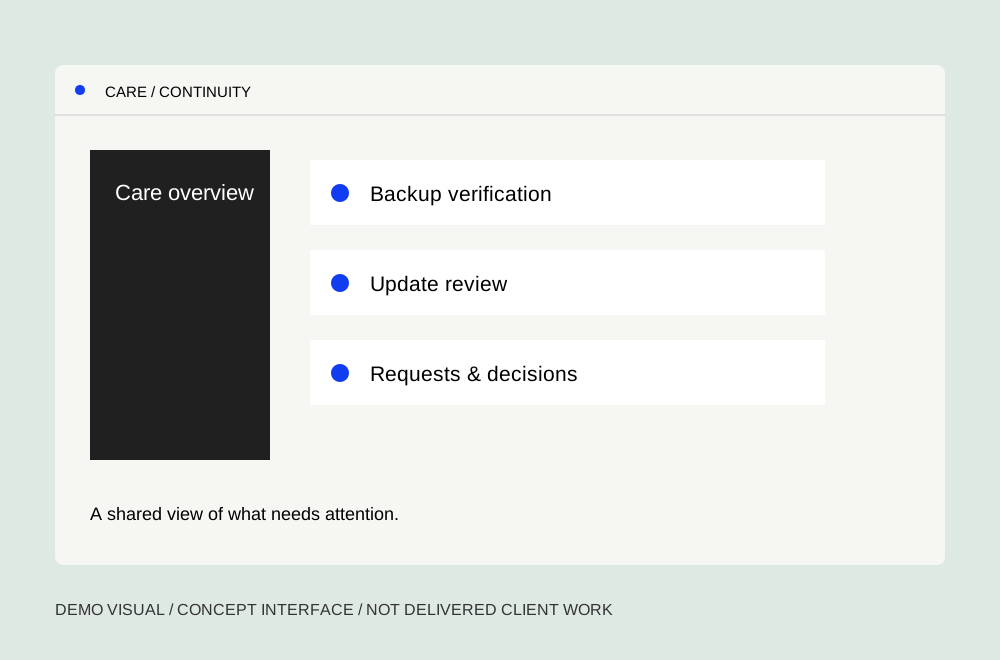
Plan backups for both files and the database, with retention, storage access, and recovery responsibilities documented. A restore exercise should use a safe environment and confirm that the backup is usable. Review updates for compatibility risk and use staging when a site’s complexity warrants it. Keep credentials protected, access proportionate, and change records available to the agency. Requests that alter templates, functionality, integrations, or the catalogue should receive separate scope review where they exceed the agreed care coverage.
QA and handoff
After an update, check the functions that matter on that site: navigation, forms, editing, checkout, or member access as applicable. Record what was changed, what was checked, and any unresolved issue. Provide a report that distinguishes completed work, failures, recommendations, and work awaiting approval. When a site leaves care, agree access removal, backup transfer, outstanding issues, and responsibility for future renewals.
Expected benefits — unmeasured
A clear intake and triage workflow may reduce confusion about what happens next. Backup and restore planning may improve readiness for recovery. Separating maintenance from project work may help the agency explain quotes and responsibilities. This scenario provides no measured uptime, response time, incident reduction, or security guarantee.
How success would be measured
Agree evidence before reporting progress: an accurate site inventory, successful backup checks, recorded restore exercises, update logs, and completion of site-specific functional checks. Review request age and status alongside impact and exclusions. A low ticket count alone does not establish service quality, and a backup success email does not demonstrate successful restoration.
Constraints and lessons to consider
Care depends on hosting access, supported software, valid licences, workable recovery options, and agreed coverage. Compromised or heavily customised sites may require a separate initial assessment. Third-party outages remain outside direct control. The practical planning lesson is to establish recovery ownership before the first urgent incident, rather than trying to decide it during an outage.